How to Recognize a Good Skier?

Are you wondering if a skier who races down the slope is a good skier? Or if the one making very wide or very tight turns is an excellent skier?
The answer is generally not clear-cut, but there are lots of little clues that can help you identify a skier with good technique. Conversely, we’ll also try to point out what should be avoided if you want to become or think you are a “good skier.”
A good skier doesn’t necessarily have the best downhill skis. They might be using older skis, but as long as their technique is solid, they’ll manage just fine!
Eyes and Head
- A good skier looks far ahead in the direction they want to go.
- Their head and chin are up and they’re not looking at their skis.
It’s very important to look ahead and not down at your feet. Looking at your skis won’t help you ski better. If you need to watch your skis to keep them from crossing, then you still need a bit more practice. Don’t worry, you’ll get there!
Arm Position
- The arms are in an attack position, forward.
- Your pole plants should be in front of your boots, not behind.
Arms play an important role in skiing; they help initiate turns with the pole plant. They should be held forward, not hanging at your sides or behind you. While skiing, you should be able to see your gloves in your field of vision.
Bringing your arms forward also helps shift your center of gravity forward. This way, you won’t be overpowered by the slope or terrain and will have full control over your skis.
This position may feel counterintuitive for beginners, but you’ll quickly understand its benefits once you become an advanced skier needing more control on steep slopes.
Body Position
- The body should be leaning forward.
- A proper alignment of « feet – hips – shoulders » is ideal.
- Upper and lower body dissociation
Beginners are often said to ski “in the back seat.” That means skiing with the weight shifted backward. The skier’s center of gravity is on their heels or even further back.
This is not a desirable position, as it makes it hard to maintain control. In this position, you’re at the mercy of the slope.
A good skier is able to bring their center of gravity forward and initiate turns with their toes, not their calves or heels!
It’s normal for beginner skiers to lean back more because they feel uncertain. As they gain confidence and technique, they’ll gradually shift their center of gravity forward.
Finally, the upper and lower body should be well dissociated. A good skier can keep their torso stable and upright while their legs do the work of absorbing and steering. This is a harder skill to master.
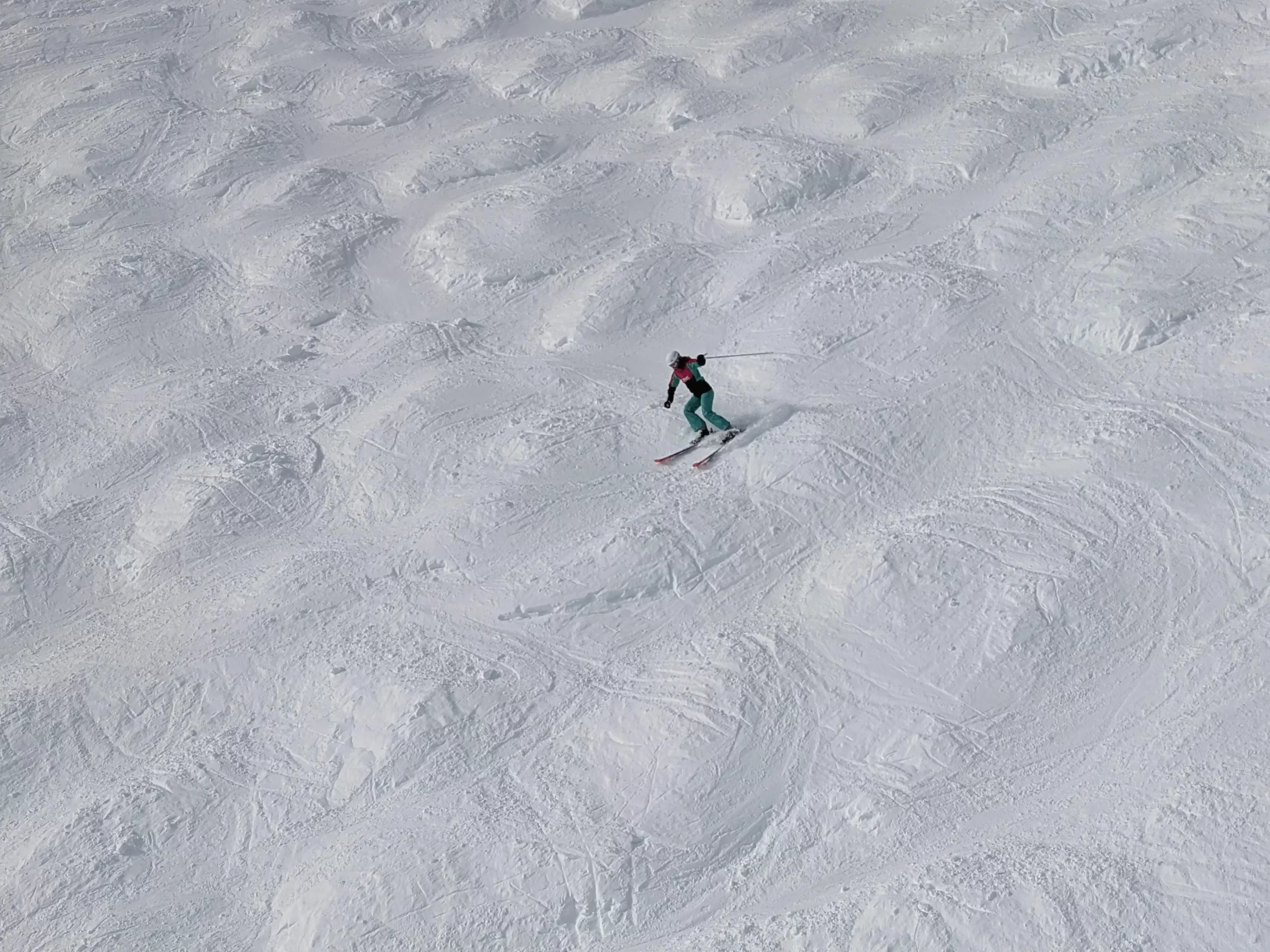
If you see a skier navigating a mogul field while keeping a stable upper body—torso still, knees moving vertically, and pole plants quick and smooth—then there’s no doubt, that’s a good, if not great, skier!
Quand changer de skis ?Turn Initiation
- The upper body initiates the turn with the pole plant.
- The legs guide the direction.
- Edge engagement starts at the ski tips, not underfoot.
A good skier can initiate a turn quickly with a slight pole plant near the ski tips. Their edge engagement happens very early, and when done well, the turn barely kicks up any snow.
A skier who skids a lot at every turn isn’t fully in control. This might be intentional to slow down, but if every turn is skidded, they should work on their technique.
Being able to carve a turn with minimal or no skidding shows the skier has great control and can stop quickly when needed.
Control of Line and Speed
- Being able to stop quickly
A fast skier isn’t necessarily a good skier. As mentioned before, if they don’t master the key techniques, they likely aren’t technically skilled.
Sure, they can go fast, which means they’re not scared… But can they stop quickly and in control? That’s the real question.
If the fast skier has their center of gravity back, they won’t have much control over their speed or direction. Best to keep your distance!
Versatility on All Types of Terrain
- Skiing in powder
- Skiing on groomed snow
- Skiing and maintaining direction on ice
- Skiing on variable snow
A “good skier” should also be able to ski on various types of terrain and snow, and adapt to any condition.
Some skiers may be specialists in one type of terrain or snow and still be excellent skiers, but in my opinion, versatility is a key trait of a “good skier.”
Evaluate Your Skiing Level
Think you’re a good skier? Evaluate your ski technique and discover your true level!


Your comments and questions